Leaving the Milky Way: The Theoretical Blueprints for Intergalactic Voyages
Is intergalactic travel possible?
In theory, YES, intergalactic travel is possible under the laws of physics, particularly through time dilation at near-light speeds or hypothetical spacetime manipulation like wormholes. However, with our current technology, it is practically impossible. The nearest major galaxy, Andromeda, is 2.5 million light-years away; even traveling at the speed of light, the journey would take 2.5 million years from the perspective of an observer on Earth (Wikipedia, 2026).
The Scale of the Problem: Why Intergalactic is Different
- Interstellar vs. Intergalactic: Explain that while interstellar travel involves the “neighborhood” (stars), intergalactic involves leaving our entire “island universe.”
- The Distance Gap: Highlight that the Voyager 1 probe, our fastest outward-bound craft, would take 75,000 years just to reach the nearest star (Proxima Centauri), making a trek to another galaxy currently inconceivable (Wikipedia, 2026).
Interstellar Travel Possible? The Gateway to the Stars
While intergalactic travel is a dream for the distant future, interstellar travel—travel between stars within our own galaxy—is much closer to reality. Technically, we have already achieved it: Voyager 1 and Voyager 2 have officially entered interstellar space. However, they aren’t “traveling” in a practical sense; it would take them tens of thousands of years to reach the nearest star system, Proxima Centauri.
How We Can Make It Happen
To make interstellar travel viable for humans or advanced probes, we must move beyond traditional chemical rockets. Several propulsion methods are currently being researched:
- Laser-Pushed Sails: Projects like Breakthrough Starshot aim to use powerful Earth-based lasers to push ultra-light “nanocrafts” equipped with reflective sails. This could theoretically accelerate them to 20% the speed of light, reaching Alpha Centauri in just 20 years.
- Nuclear Thermal & Fusion Propulsion: By using nuclear reactions instead of chemical combustion, we could achieve significantly higher thrust-to-weight ratios, cutting travel time to nearby stars down to centuries rather than millennia.
- Antimatter Engines: The “holy grail” of propulsion. Colliding matter with antimatter releases 100% energy efficiency. While we can create antimatter in particle accelerators today, we cannot yet produce or store it in the quantities needed for fuel.
In short, interstellar travel is physically possible and technologically foreseeable. The transition from “probes” to “crewed missions” simply depends on our ability to master high-energy propulsion and long-term life support.
Comparison: Interstellar vs. Intergalactic Travel
| Feature | Interstellar Travel | Intergalactic Travel |
|---|---|---|
| Primary Destination | Nearby stars (e.g., Alpha Centauri) | Neighboring galaxies (e.g., Andromeda) |
| Distance Scale | 4 to 100+ Light-Years | 2.5 Million to Billions of Light-Years |
| Travel Time (Current Tech) | Tens of thousands of years | Millions to billions of years |
| Energy Requirements | High (Petajoules for small craft) | Extreme (Equivalent to total stellar output) |
| Main Obstacle | Propulsion and life support | Time, cosmic expansion, and extreme radiation |
Theoretical Methods & the Einstein-Rosen Bridge
While current engineering falls short, physics provides several blueprints for crossing the cosmic void. The most promising—and popular—theoretical methods involve manipulating the fabric of the universe itself.
Wormholes and the Einstein-Rosen Bridge
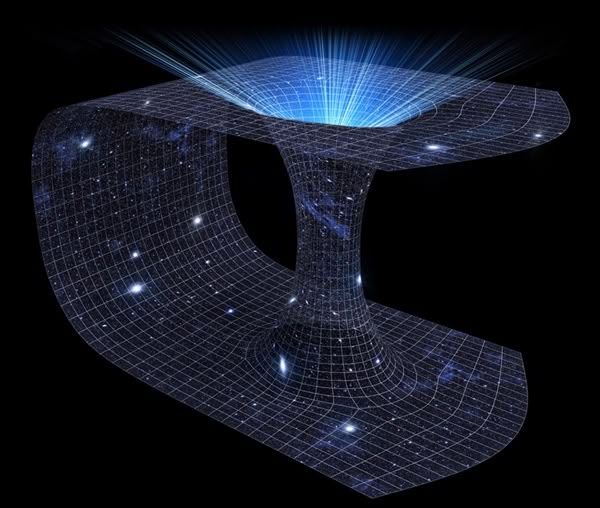
The most famous “shortcut” through the universe is the wormhole, formally known as an Einstein-Rosen Bridge. Proposed by Albert Einstein and Nathan Rosen in 1935, this theory stems from General Relativity, which treats space and time as a single, flexible fabric called spacetime.
Einstein suggested that massive objects don’t just sit in space; they warp it—much like a bowling ball sitting on a trampoline. A wormhole occurs if spacetime is warped so severely that two distant points are brought together, creating a “tunnel.” Instead of traveling millions of light-years across the surface of space, a ship could theoretically pass through the tunnel to appear instantly in another galaxy. However, these bridges are mathematically unstable; keeping one open would require “exotic matter” with negative energy density to prevent the tunnel from collapsing into a black hole.
The Alcubierre "Warp" Drive
If we cannot take a shortcut, we might move space itself. The Alcubierre Drive suggests a craft that doesn’t “move” in the traditional sense. Instead, it sits inside a “warp bubble.” The engine would contract spacetime in front of the ship and expand it behind. Because the ship is stationary within the bubble—and it is space itself that is moving—the craft could technically arrive at a destination faster than light without violating Einstein’s laws.
Relativistic Time Dilation
For a more “grounded” method, we look to Special Relativity. As an object approaches the speed of light ($c$), time for the traveler slows down relative to those back on Earth. At $0.999c$, a 2.5-million-year trip to Andromeda could feel like only a few decades to the crew. While feasible in physics, the energy required to accelerate a ship to these speeds is currently beyond human capability.
The Biggest Hurdles (The "Reality Check")
Cosmic Expansion (The "Runaway" Target)
The universe isn’t static; it’s expanding. Thanks to dark energy, galaxies are moving away from each other. Because this expansion happens across the vastness of space, the distance between us and a distant galaxy can increase faster than the speed of light. This creates a “cosmological. horizon”—if a galaxy is far enough away, even a ship traveling at light speed would never reach it because the space between us is growing too fast to cross.
Extreme Radiation (The Cosmic Microwave Ovens)
Intergalactic space is not just empty; it is permeated by the Intergalactic Medium (IGM) and high-energy cosmic rays. Without the protective “bubble” of our sun’s heliosphere or Earth’s magnetic field, travelers would be bombarded by subatomic particles moving at near-light speeds. Over a journey of millions of years, this radiation would shred human DNA and eventually degrade the very hull and computer systems of the spacecraft.
The Energy Gap (The Fuel Problem)
To reach another galaxy in a human lifetime, you must travel at relativistic speeds (near the speed of light). According to Einstein’s equation,E=mc2
, as an object goes faster, its “relativistic mass” increases, requiring exponentially more energy to continue accelerating.
- The Reality: To accelerate a small ship to Andromeda-capable speeds would require more energy than our entire sun produces in its lifetime. We currently have no way to store or generate that much power.
Editor’s Opinion: The Final Frontier or a Beautiful Dream?
From a modern scientific perspective, intergalactic travel is the ultimate “high-risk, high-reward” thought experiment. While the math behind Einstein-Rosen bridges and Alcubierre drives is sound, we must remain grounded: we are currently a Type 0.7 civilization on the Kardashev scale. To move space-time or power a relativistic ship, we would likely need to harness the energy of entire stars. However, the history of science is a history of the “impossible” becoming routine. Just as the sound barrier was once thought unbreakable, the light-speed barrier and the intergalactic void represent the next great challenges for the human spirit. Even if we never physically set foot in Andromeda, the pursuit of these technologies drives innovation in propulsion, materials science, and energy that benefits us here on Earth today. The “gap” isn’t just a distance; it’s a dare.
Sources & Credits
This article was compiled using data from leading astronomical and physical research archives. For a deeper dive into the mathematics and mission logs, visit the links below:Wikipedia: Intergalactic Travel– A comprehensive overview of the physics and proposed methods.
SciRP: Exploring the Alcubierre Warp Drive – Technical paper on the feasibility of warp bubbles.
New Space Economy: Space Misconceptions – Fact-checking common myths about the vacuum of space.
NASA/JPL: Voyager Mission Status – Real-time data on humanity’s first interstellar messengers.
Breakthrough Starshot – Official site for the laser-sail project to Alpha Centauri.
Disclaimer
Educational Purposes Only: The content of this post is for informational and educational purposes. While based on established theories of physics (such as General and Special Relativity), many of the propulsion methods discussed (Warp Drives, Wormholes) remain purely theoretical. They have not been proven as viable for human transport and often rely on “exotic matter” or energy levels that are not currently attainable by modern technology. Always consult the latest peer-reviewed journals for up-to-date scientific consensus.